





Let’s look at the comparison in the female age group u14 to u16. Both players have different grip patterns on the two-handed backhand.
Detailed Analysis
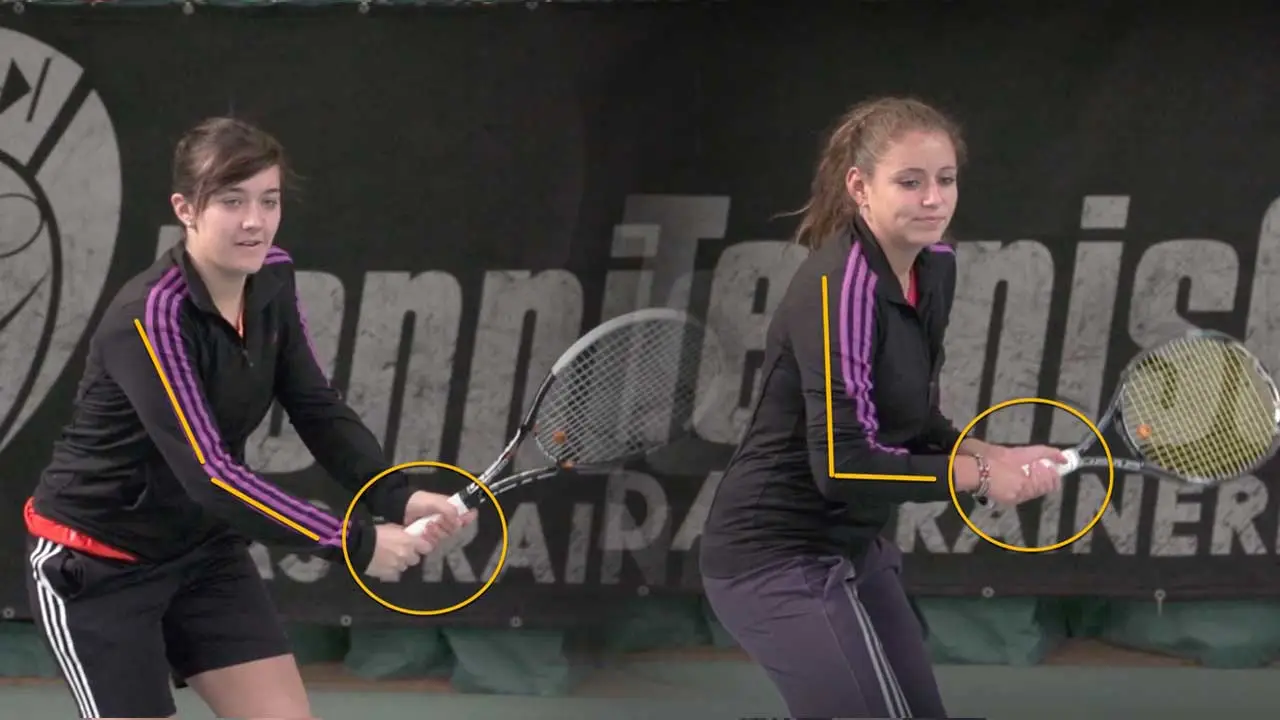
The u16 player (left) has a continental grip with the hitting hand, the u14 player on the right has a forehand eastern grip. With the left hand both players hold the racquet with a clear forehand grip.
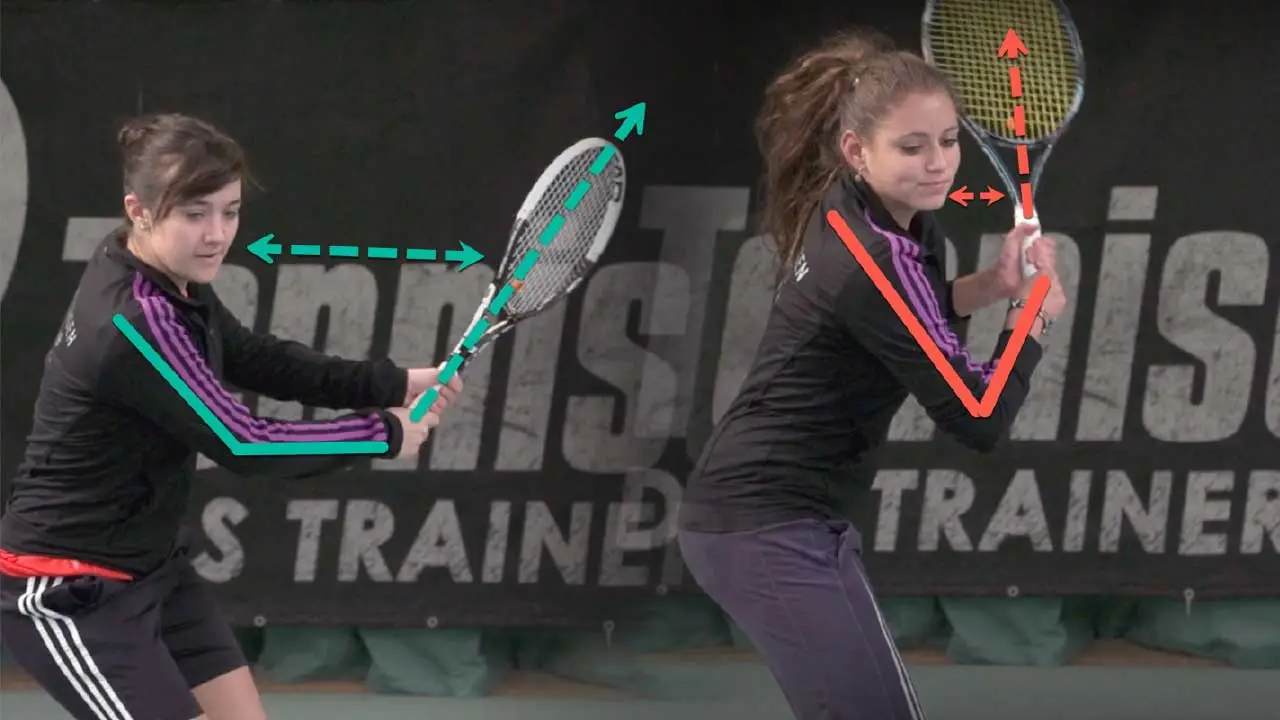
The arm position is characteristic here. The u14 player with the strong forehand grip in the hitting hand bends her arms very strongly and tends to get her power from the angles of the arms. The u16 player with the milder grip on the hitting hand uses her upper body a lot. The arms are therefore also further away from the body. This ensures a consistent “one-piece take-away” (term from golf), i.e., a repeatable take-away in one piece (over the hips and upper body). This is certainly something to strive for. The strong angling of the arms in the player on the right is to some extent due to the grip and can be observed very often in the youth range.
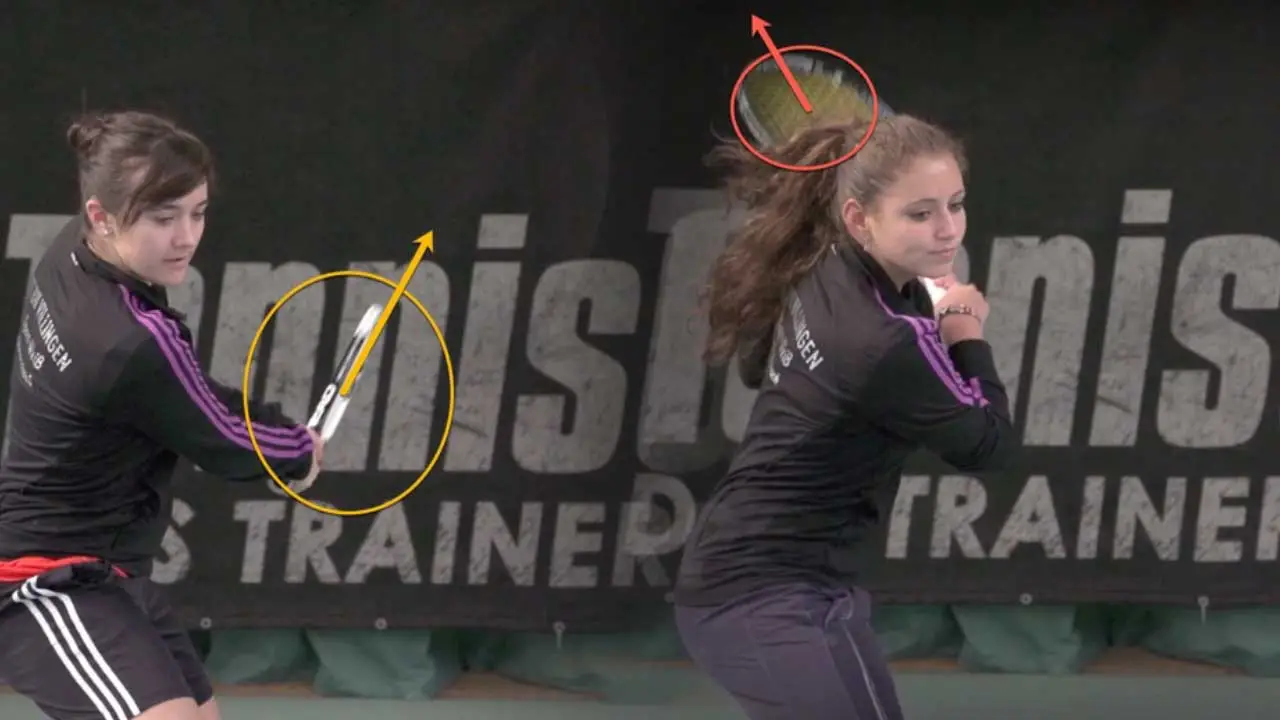
In the further progression of the stroke, the player on the left stays with the racquet outside the body, the player on the right swings inward. The racquet is opened strongly, which is rather unfavorable. After all, an opened racquet must be closed again towards the point of impact. With fast balls, “mis hits” are more frequent.
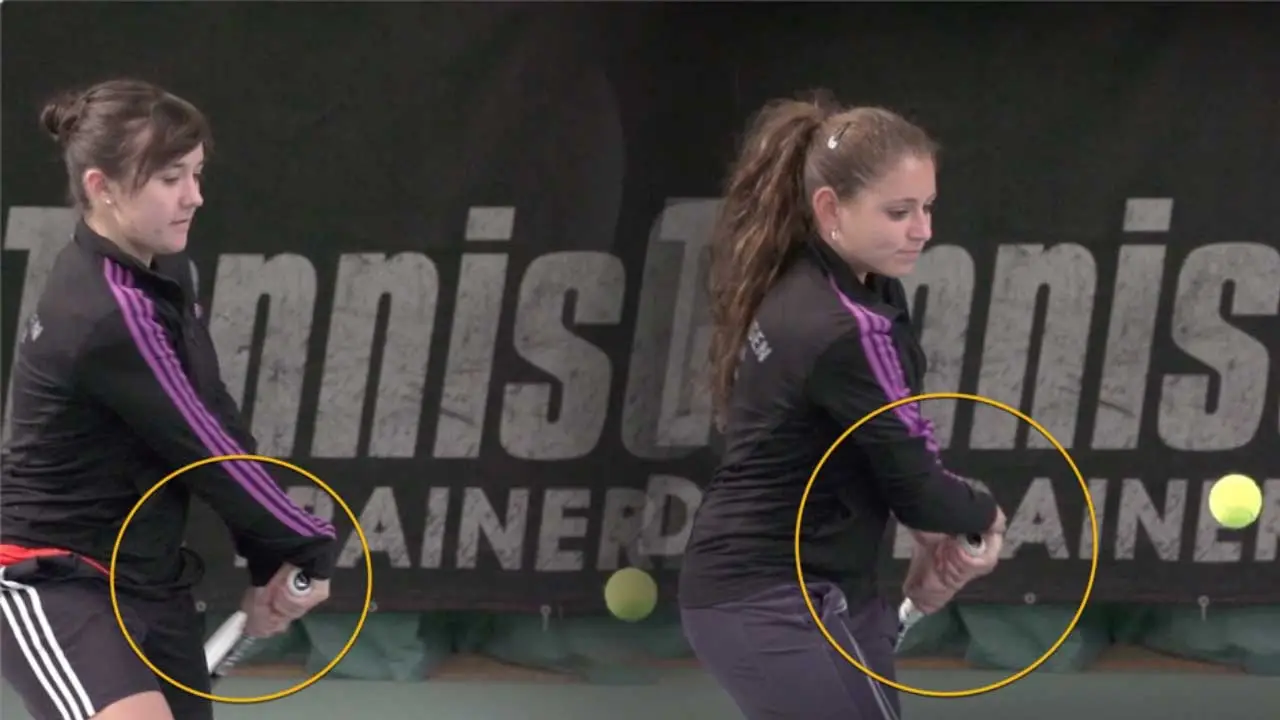
Shortly before the contact point, both players are almost identical here. The racquet points downward, the wrists are strongly bent. This allows the racquet to reach the ball from the bottom up. A prerequisite for the forward spin.
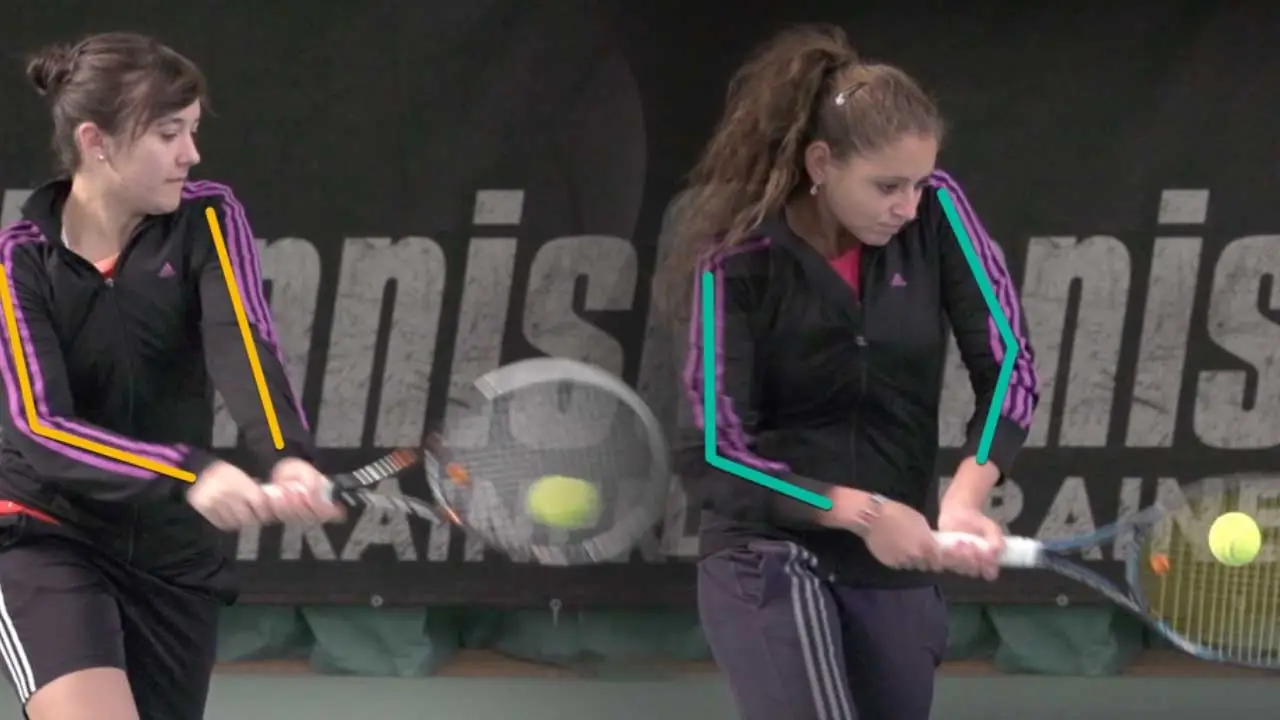
The contact point again shows strong differences. The u16 player extends her hitting arm, while the u14 player on the right has both arms angled almost identically. This can also be observed frequently with the „forehand-forehand” grip combination. This main action is caused by the two different helping actions. Both hit the ball solidly. Many roads lead to Rome. However, it is clear that the left-handed player finds one-handed backhand strokes much easier (RH volley and RH slice). Her grip on the hitting hand is already prepared here. The player on the right would have to reach around – or, as is often the case, retain the grip anyway – and comes up against limits here.
Coaching Keys – Junior Development
Hand Position Awareness
- Teach juniors that each hand has a different role on the racket.
- The bottom hand stabilizes, while the top hand drives the swing.
- Encourage relaxed hands so the racket can accelerate naturally.
Correct Grip Combination
- Use a Continental grip for the bottom hand.
- Use an Eastern forehand grip for the top hand to control the swing.
- Check grip positions regularly during practice routines.
Top Hand Dominance
- Explain that the top hand acts like a forehand stroke.
- Encourage players to feel that the top arm leads the swing path.
- Promote brushing movement to generate topspin.
Stable Preparation
- Establish an early unit turn with both hands on the racket.
- Keep the racket stable through preparation to avoid grip changes.
- Maintain balance and strong posture before the swing.
Relaxed Bottom Hand
- The bottom hand should guide, not dominate the stroke.
- Avoid excessive tension in the lower hand.
- Allow the bottom hand to support stability and timing.
Grip Adaptation Skills
- Teach players that small grip adjustments help adapt to ball height and spin.
- Encourage awareness of racket-face angle rather than rigid grip positions.
- Develop the ability to adjust grips naturally in different situations.
Coordination Development
- Use shadow swings and slow feeds to build hand coordination.
- Focus on the connection between both hands and the body rotation.
- Reinforce the feeling of both hands working together, not fighting each other.